

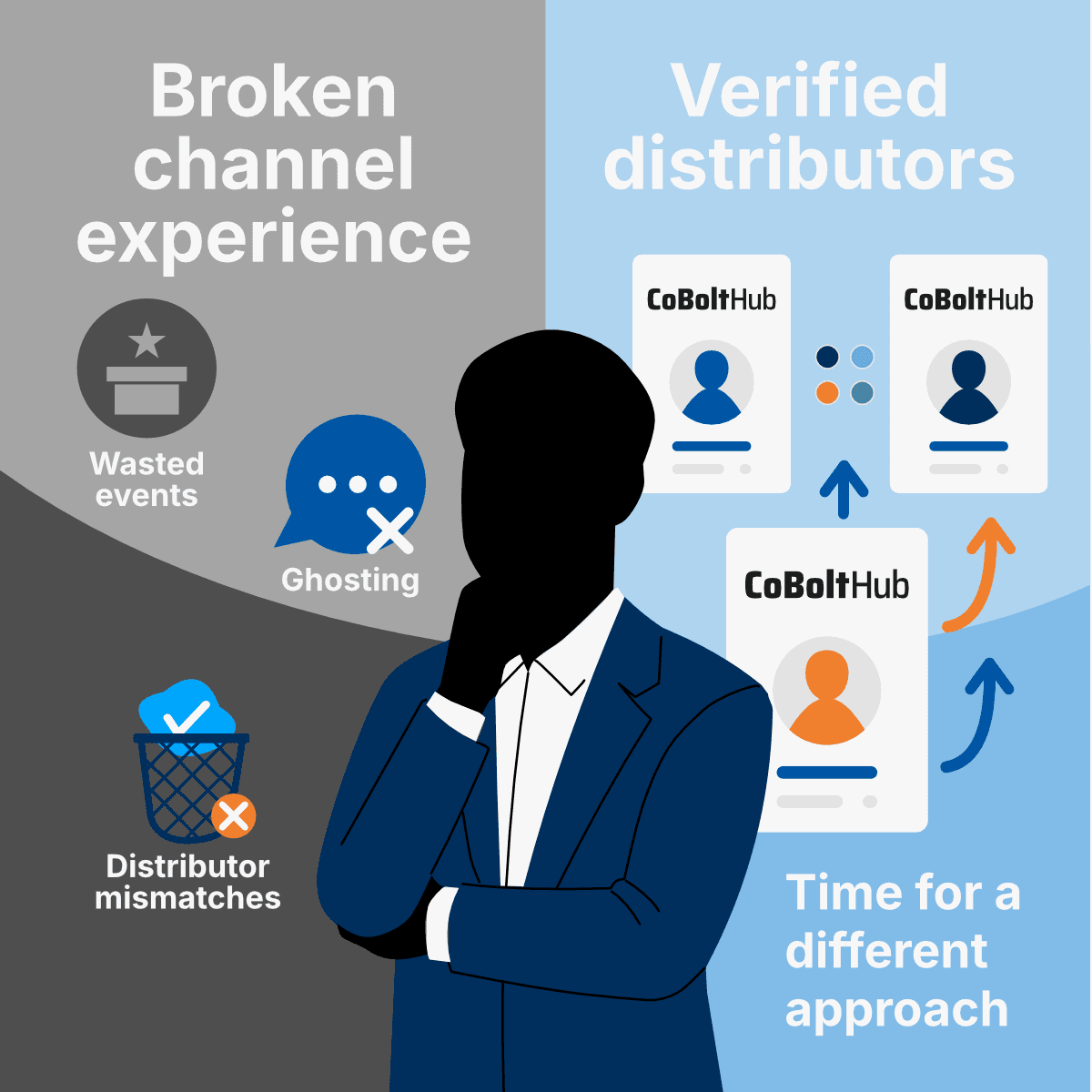
Anyone who has spent serious years in the software channel eventually lands on the same uncomfortable truth. Partnerships are the engine of so much enterprise growth, yet the way most companies find their partners is closer to folklore than to a discipline. It is built on brand familiarity, ranking sites, legacy networks and the vague hope that a good handshake will carry the rest.
I spent over two decades inside a Fortune 100 software business across Asia, and I watched this play out in slow motion. New regions would open, markets would contract, ecosystems would reshape themselves in real time, and companies would scramble to find partners who could actually deliver. Most of them failed to do it well. Not because they were incompetent, but because the tools simply were not there.
That is the honest origin of CoBolt Hub. We did not set out to build a directory, because directories were never the problem worth solving. We built CoBolt Hub because we believe discovery is the most important part of any partnership, and it is the part the industry has quietly neglected for two decades.
Existence Is Not Intent
Let me be precise about the failure I keep seeing. Most companies confuse the existence of a partner with the intent of that partner. A distributor lists itself in a directory, so it must be available. A vendor has a partner page, so it must be recruiting. Neither of those things tells you anything useful when you are trying to decide whether a relationship deserves your budget, your roadmap and your reputation.
I have watched teams invest months evaluating partners who were never going to convert. They built the spreadsheets, ran the calls, attended the events and collected the business cards, only to discover that the supposed candidate had no real capacity, no aligned strategy and no genuine desire to sell their product. Every partner overstates their strengths early. That is not malice, it is just how the market has always worked when there is no structure forcing honesty.
The consequence is that early misalignment becomes downstream frustration. Companies end up trying to fix partnerships while the business is already in motion, and that is assuming the problem is fixable at all. By the time the misalignment surfaces, in the form of missed revenue targets or delivery surprises, the cost of correction is often higher than the value of the relationship. I have seen that equation fail far too many times.1
The ecosystem is undergoing its most profound structural change in two decades, and most companies are still using discovery methods built for a slower, more forgiving era.
The Industry Moved On, the Methods Did Not
Here is what makes this urgent rather than merely annoying. The global channel is not static. New distribution models, hyperscaler marketplaces and shifting regional demand have made the partner ecosystem far more fluid than it was when most of today's discovery habits were formed. Relying on who you already know is a strategy that quietly caps your growth at the size of your existing network.
In my experience, that is exactly where ambitious companies get stuck. Their internal teams can only cover so many markets and so many customers directly. When growth plateaus because reach has hit its ceiling, the answer is supposed to be the channel. Yet the very act of finding the right channel partners remains slow, subjective and expensive.
Consultants can help, but they are costly and slow to deliver certainty. Industry events generate more business cards than relationships. Cold outreach reveals nothing about intent. And the information you do gather is scattered across separate platforms, inboxes and conversations. None of these tools were built for high-stakes decisions, yet we keep using them as if they were.
Discovery Is a Workflow, Not a Task
My view is simple. Discovery should not be a series of isolated tasks. It should be a continuous workflow where each stage builds context for the next, so teams do not lose information, repeat work or restart alignment every time priorities change.
That belief is the architecture of CoBolt Hub. We treat the first mile of partnership, before onboarding or management even begins, as the most important ground to get right. The platform is built so companies capture their capabilities, coverage and intent in a partner-ready profile first. Only then do they define their expansion goals and evaluation criteria, and only then do they search.
This sequence matters more than it sounds. When you define what you are looking for before you start looking, you stop drifting toward whatever is loudest. You establish your strategic, commercial, product and operational criteria upfront, and every candidate is measured against the same standard. That is how decisions become defensible rather than merely hopeful.
Once companies search, CoBolt Hub surfaces more than a list of who exists. It shows who aligns, because profiles carry real signals of capability, coverage and intent. Partners who clearly share their interests and priorities rank higher, which means the time your business development team invests goes to partners who are active, aligned and ready to engage.
Two Sides of the Same Broken Process
What surprised me most when we started was how symmetrical the problem is. Software principals and value-added distributors suffer from the same broken discovery, just from opposite directions.
Principals cannot easily tell which distributors are genuinely committed to their market versus those who list themselves everywhere. Distributors, meanwhile, struggle to prove they are the capable, certified, delivery-ready partner they actually are, because directories flatten their strengths into a generic entry. Both sides waste enormous effort trying to signal and decode intent through channels that were never designed for it.
CoBolt Hub is built for that two-way fit. Both sides use the same underlying workflow, with journeys tailored to how each discovers, evaluates and engages. A principal can test whether a market is viable before committing budget, by seeing which distributors are already active there. A distributor can spot which principals are investing in its region rather than merely announcing global ambitions. Intent becomes visible in both directions, and that changes the quality of every conversation that follows.
Start With Fit, Not Fixes
The phrase we keep coming back to internally is that we want companies to start with fit, not fixes. Too much of the channel industry is organised around repairing relationships that should never have been signed. By focusing on the first mile, CoBolt Hub helps teams surface misalignment early, reduce partner risk and accelerate decisions.
There is a commercial consequence to this that leaders should not ignore. When discovery is structured, business development spend drops because prioritisation happens upfront. When evaluation is consistent, shortlists are delivered faster without cutting corners under corporate pressure. When intent is visible, teams stop spending months on partners who were never serious. Each of these is a measurable improvement to the top line and to the sanity of the people carrying the revenue target.
And when an expansion plan is not set up to succeed, because expectations do not match market realities, the platform gives teams an earlier, clearer signal to make a go/no-go decision. That alone has value. Knowing when not to enter a market is as commercially important as knowing when to commit.
Why We Built This
I have spent enough years watching smart companies make avoidable partner mistakes to know that the problem is not a shortage of ambition. It is a shortage of structure. The tools simply did not exist to make discovery rigorous, consistent and honest, so companies defaulted to the informal, the fragmented and the familiar.
That is why we built CoBolt Hub. Not to add another list to an already crowded market, but to give teams the operational infrastructure to discover the right partners with confidence. We believe teams should be able to demonstrate their strengths, connect with genuine intent and evaluate consistently. When that happens, strategic expansion becomes faster, replacements become smarter and opportunities become more visible.
The channel is not going to slow down to accommodate outdated habits. The question is whether companies will treat discovery as the strategic advantage it can be, or continue paying the quiet price of getting it wrong. My view is that the ones who choose structure will be the ones still growing when the market shifts again.
And it will shift again. It always does. CoBolt Hub - CoBolt Hub is a structured partner discovery platform for software principals and Value-Added Distributors, built around capability, coverage, and intent signals.
Sources
Footnotes
-
Global Channel Partners Report 2025-2026 - Industry analysis noting that the global channel partner industry is navigating its most profound structural transformation since the advent of the managed services model two decades ago, supporting the article's argument that discovery methods have not kept pace with ecosystem change. ↩