

The Problem Was Never the Partner
In my experience, the most expensive partnership decision a software company makes is rarely the one it debates the longest. It is the one it makes quickly, with incomplete information, because a market is opening, a quarter is closing, or a distributor looked impressive in a single meeting.
I have watched this pattern repeat across two decades of APAC expansion, and it almost never announces itself as a mistake. It arrives disguised as an onboarding problem, a training gap, or a slow ramp. By the time the truth surfaces, the business is already in motion. The pipeline is committed. The regional team has been hired. The customer has been promised a partner who, quietly, was never the right fit at all.
So let me be direct about the thesis here: misaligned partners are not a management failure. They are a selection failure. And most organisations keep trying to fix at onboarding what should have been resolved at discovery.
Misalignment Is the Norm, Not the Exception
The instinct is to treat a bad partnership as bad luck. The data suggests otherwise. According to research from CRN, 70% of partners have either ended a relationship with a vendor or stopped selling the vendor's products entirely, which means churn and disengagement are structural features of the channel, not anomalies1. Partner ecosystems churn constantly. Vendors onboard partners who were never positioned to succeed, then wonder why the relationship stalls six months later.
I have seen the same dynamic from the other side of the table. A distributor takes on a principal because the logo looks good on the portfolio, only to discover that the principal has no enablement budget, no local support model, and no real intention of investing in the region. Both parties entered the relationship with different expectations. Neither said so out loud. Both spent the next year trying to manage a mismatch that no amount of quarterly business reviews could repair.
The uncomfortable conclusion is this: in most cases, the misalignment was visible at the start. It was simply not surfaced, because nobody had a structured way to look for it.
The Hidden Cost of Discovering Fit Too Late
The commercial damage of a misaligned partner compounds in ways that rarely appear on a single line of a P&L.
First, there is the direct cost of wasted business development. Months of relationship building, travel, joint planning, and internal advocacy, spent on a partner who was never going to convert. That is not a rounding error. In a market where expansion budgets are scrutinised, it is often the single largest drain on channel investment.
Second, there is the opportunity cost. Every quarter spent fixing a partner who cannot deliver is a quarter not spent with one who could. In fast-moving markets, that delay is not neutral. Competitors with better-aligned partners simply move faster, and the market does not wait for a vendor to finish repairing a relationship it should never have started.
Third, and most damaging, there is the erosion of internal credibility. When a regional expansion underperforms, the instinct is to blame the market. But leadership eventually asks a harder question: how did we choose this partner in the first place? If the answer is a spreadsheet, a referral, or a gut feel, the problem is not the partner. It is the process.
Why the Status Quo Keeps Producing the Same Result
The reason misalignment persists is not a shortage of effort. It is a shortage of structure at the exact moment structure matters most.
Most organisations rely on the same handful of tools for partner discovery, and each of them has a structural blind spot. Directories give you a list of who exists, not who aligns. Consultants deliver certainty slowly and expensively, and often after the decision window has closed. Cold outreach reveals nothing about intent, because a partner's willingness to take a meeting says nothing about their capacity to deliver. Industry events generate more business cards than genuine relationships. And every partner, in the early stages, overstates their strengths, because that is what the format rewards.
The result is that the most consequential decision in the partnership lifecycle, the decision of who to work with, is routinely made on the weakest possible evidence. Then the organisation spends the next eighteen months trying to compensate for that gap with management effort, which is a bit like trying to fix a foundation by repainting the walls.
Discovery Is a Decision, Not a Step
My view is simple. Discovery is not an administrative step before the real work begins. It is the decision. Everything downstream, onboarding, enablement, joint go-to-market, is execution against a choice that has already been made. If that choice is sound, execution compounds. If it is not, execution only accelerates the arrival of a problem.
This is why I think the language of "partner management" is often misplaced. You cannot manage your way to alignment. Alignment is either established before commitment or it is absent. What most teams call partner management is, in truth, the expensive and largely futile attempt to manufacture fit after the fact.
The organisations that get this right treat discovery as a continuous workflow rather than a set of isolated tasks. They define what alignment actually means for a given market, in terms of capability, coverage, specialisation, and intent, before they search. They evaluate candidates against consistent criteria rather than against the persuasive energy of whoever presented last. And critically, they build a record of why a decision was made, so that judgement is reviewable rather than remembered.
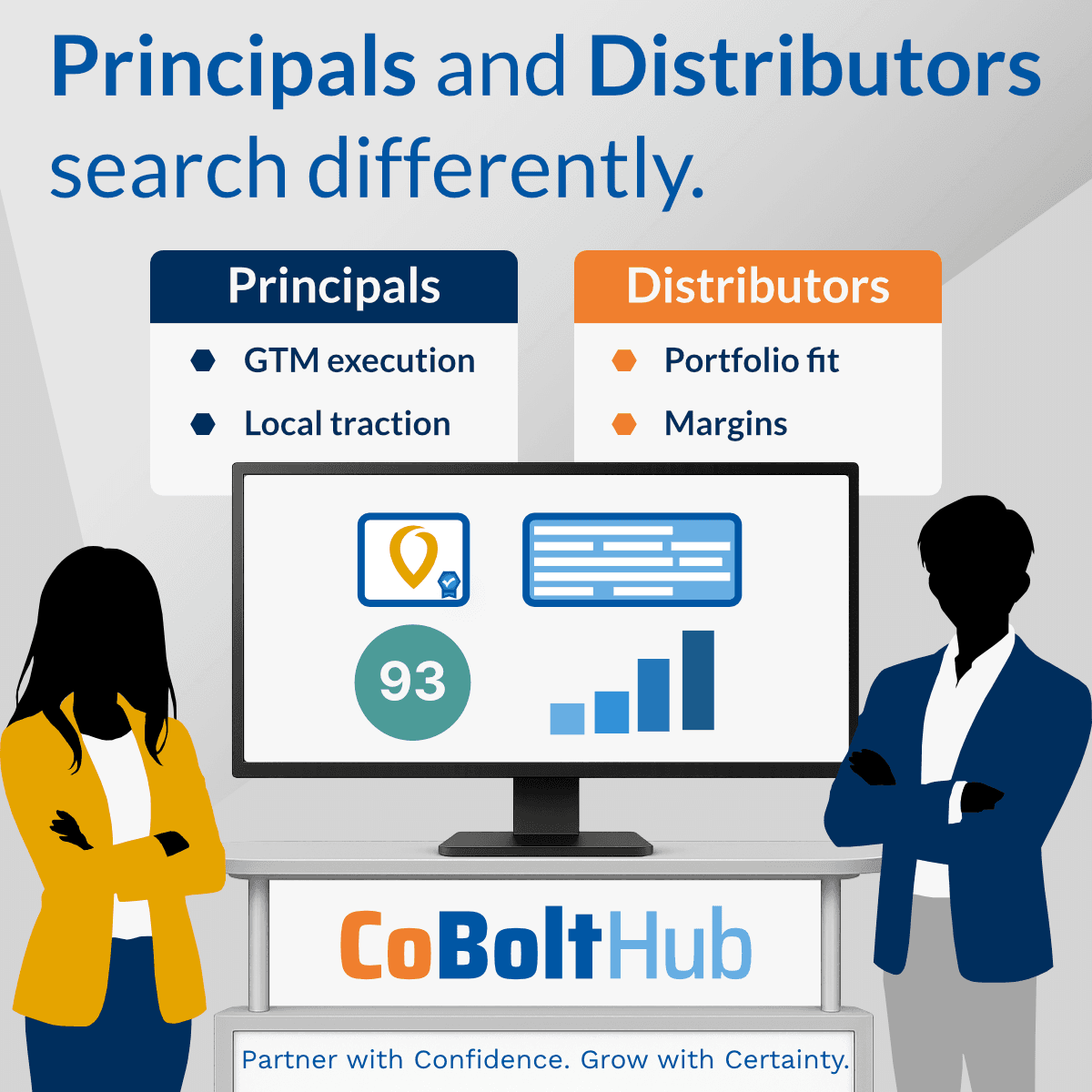
This is the thinking behind CoBolt Hub. It treats partner discovery as the first mile of the partnership, the stage where misalignment should be surfaced rather than inherited. Profiles capture capability and intent in a partner-ready format. Projects let teams define market entry goals and evaluation criteria upfront. Search and filters surface partners who align, not merely exist. And structured evaluation means every shortlist is backed by reasoning that can be defended, not just asserted.
What Both Sides Actually Want
Here is the part that gets lost in the finger-pointing. Misalignment is not a principal problem or a distributor problem. It is a mutual one, and the costs fall on both sides.
A software principal that commits to a Value-Added Distributor without verifying intent wastes business development cycles, burns internal credibility, and delays market entry. A VAD that takes on a principal without checking whether that vendor will actually invest in enablement, support the engineering team, and protect its reputation carries the risk directly into its customer relationships. Both parties lose. Both parties also, usually, knew enough to ask better questions at the start.
The honest constraint here is that no platform can fix a weak proposition. If a product is not competitive, or a distributor does not genuinely serve its market, better discovery will simply surface that truth faster. That is not a flaw. It is the point. The purpose of structured discovery is not to guarantee a successful partnership. It is to stop organisations from investing heavily in partnerships that were never positioned to succeed.
The Cost of Doing Nothing
I have spent years watching companies try to repair partnerships that should never have been formed. The pattern is consistent, and so is the cost. Wasted spend. Delayed expansion. Eroded trust between regional teams and headquarters. And, in the worst cases, a market that closes before the organisation has finished untangling a relationship it chose too quickly.
The companies that avoid this are not smarter about partners. They are more disciplined about discovery. They decide what fit looks like before they go looking for it, and they refuse to let enthusiasm substitute for evidence.
My advice to any leader weighing a new market or a new partner is straightforward. Stop treating discovery as the paperwork before the real decision. Treat it as the decision itself. Because by the time a misaligned partner is visible in your pipeline, the choice that created it is long past, and the only thing left to manage is the cost.
CoBolt Hub - CoBolt Hub is a structured partner discovery platform for software principals and Value-Added Distributors, built around capability, coverage, and intent signals.
Sources
Footnotes
-
CRN Research, cited by The Channel Co. - CRN Research found that 70% of partners have either ended a relationship with a vendor or stopped selling the vendor's products, illustrating that partner churn and disengagement are structural features of the channel. ↩