

Launch Day Is a Statement About Where Channel Decisions Go Wrong
CoBolt Hub is live. The platform is now open to software companies and Value-Added Distributors building partner ecosystems across regions, and the timing is deliberate.
The channel partner services market is expanding from roughly $689 billion in 2025 to an estimated $755 billion in 2026, a growth rate near 9.6%1. Capital is moving into indirect routes faster than most channel teams can rebuild the processes that support them. Expansion plans are approved before the partner landscape is properly understood. Shortlists are assembled from directories, conference contacts, and inherited relationships. Contracts are signed on the strength of a pitch, not on evidence of fit.
CoBolt Hub's view is that this sequence is backwards. The most consequential decisions in a partner programme are made in the first mile, before onboarding, before enablement, before the first joint pipeline review. That is the stage this platform was built to serve.
The Launch Announcement, Stated Plainly
CoBolt Hub is a platform to search, score, and shortlist software principals and Value-Added Distributors through structured evaluation and real intent signals. It is free to use. It supports both sides of the channel. It focuses exclusively on discovery and early evaluation, and it does not attempt to replace a CRM or a partner portal.
Those four sentences define both the ambition and the boundary of the product. The ambition is to make partner discovery a repeatable workflow rather than an improvised exercise. The boundary is deliberate: once a partnership moves into contracting and management, the existing systems should carry it. Discovery is where the platform invests.
Why Discovery Deserves Its Own Infrastructure
Most channel technology addresses what happens after a partner says yes. Partner relationship management systems track deal registration, deal margins, certifications, and co-marketing activity. Partner portals distribute collateral and training. These tools assume the relationship already exists and is worth maintaining.
Very little infrastructure addresses the question that precedes all of it: which partner, in which market, is genuinely capable and genuinely interested right now?
In practice, that question is answered through a patchwork. A business development lead pulls a list from a directory. A regional manager adds names from a previous employer. A consultant delivers a market map with limited verification. Conversations happen across email, messaging apps, and spreadsheets, and the reasoning behind a shortlist disappears the moment the person who built it changes role.
CoBolt Hub treats this as a workflow problem, not a research problem. Each stage builds context for the next, so information is not lost and alignment does not restart when priorities shift.
The Six Stages, and What Each One Produces
A launch announcement is only useful if it explains the mechanics. The platform runs on six connected stages.
Build a company profile. Principals and VADs capture capabilities, coverage, specialisation, and intent in a partner-ready format. The profile is the foundation of every subsequent match, which is why the platform asks for structured inputs rather than free-text marketing copy.
Plan the expansion. Teams define market entry goals, partner requirements, and evaluation criteria before searching. This ordering matters. When criteria are set in advance, the search becomes a filter against a standard rather than a hunt for justification.
Search and discover partners. Discovery uses search, filters, project criteria, intent signals, and platform recommendations. The distinction from a directory is that results are ranked by alignment, not by listing status.
Connect with confidence. Connections are consent-based. Both parties see context before a conversation begins, which removes the cold outreach dynamic that consumes so much business development time.
Evaluate fit and drive actions. Teams assess capability against their own criteria, compare candidates side by side, and complete evaluation tasks inside a structured workflow. The output is a shortlist with reviewable reasoning.
Monitor signals and outcomes. Dashboards surface partner intent, engagement, recommendations, and workflow progress over time. Discovery becomes continuous rather than episodic.
What Changes Commercially
The commercial case rests on three measurable effects.
First, risk falls. When capability, coverage, and intent are assessed through consistent information, weak candidates are filtered earlier. The platform surfaces intent signals across profile details, intent fields, and project criteria, so partners who clearly state their interests and priorities rank higher. This is a meaningful shift from the channel norm, where every distributor presents itself at maximum strength in the first meeting.
Second, decisions become defensible. A shared evaluation framework produces a record of why a partner was shortlisted and why another was not. For teams operating under corporate timelines, that record matters as much as the outcome. It converts a judgement call into a documented process.
Third, wasted spend declines. Business development effort is finite. Every month spent evaluating a partner who was never going to convert is a month not spent on a partner who would have. Prioritisation upfront redirects that effort.
There is a fourth effect that is harder to quantify but frequently more valuable. Teams can test assumptions before committing budget. A principal considering a new region can see which distributors are already active there, what categories they support, and whether their existing vendor portfolio aligns. That early read functions as a simulation, and it can support a timely no-go decision just as easily as a go decision.
Both Sides of the Same Workflow
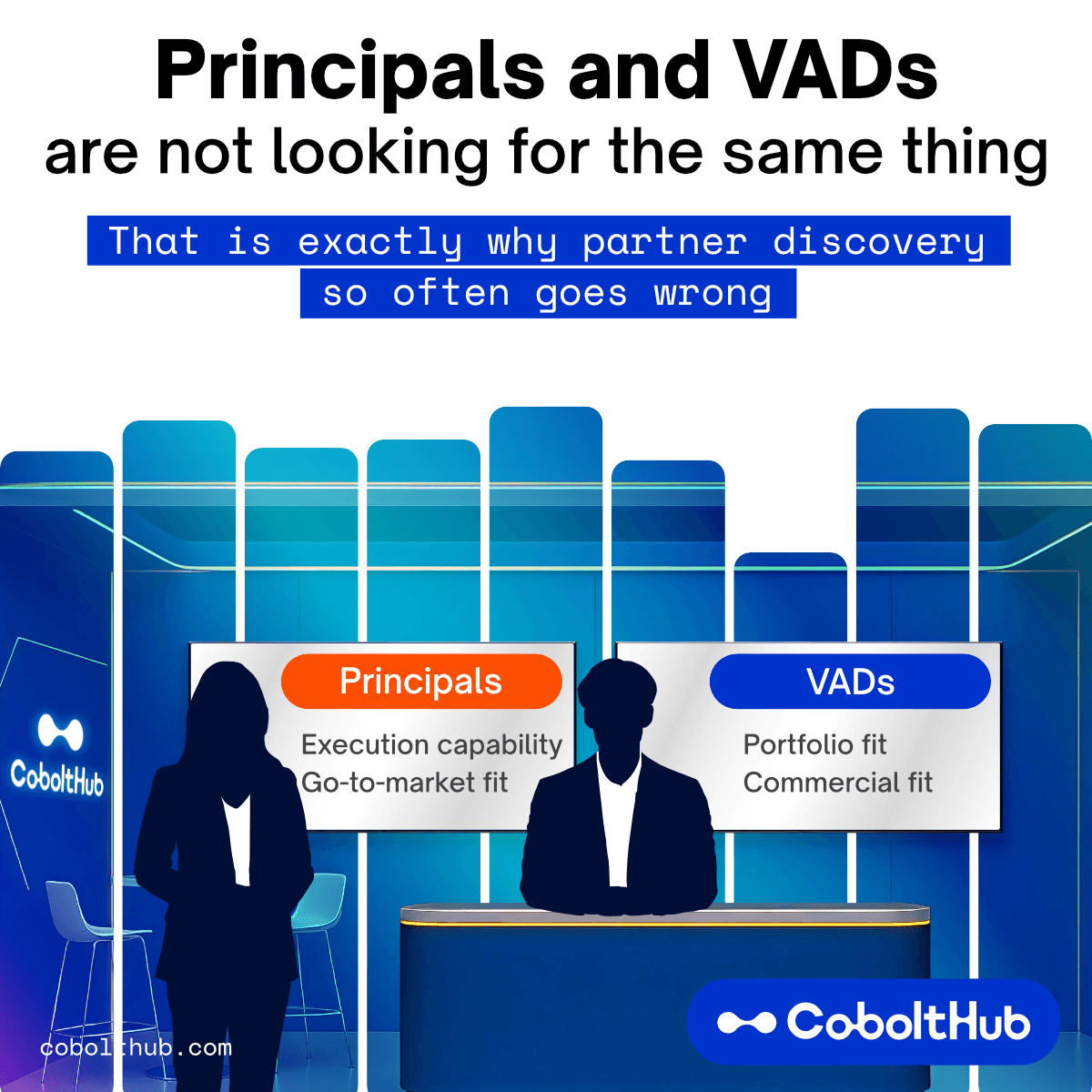
CoBolt Hub's position is that discovery is structurally symmetrical. Principals evaluate distributors. Distributors evaluate principals. The information asymmetry runs in both directions, and both sides currently compensate with intuition.
For principals, the recurring problem is that directories provide lists rather than alignment. Consultants are expensive and slow. Cold outreach reveals nothing about intent. Distributors overstate their strengths early, and the gap only becomes visible during delivery.
For VADs, the problem is inverted. Capable distributors struggle for visibility because there are few places to present strengths in a complete, structured form. Principals list themselves everywhere without demonstrating commitment to a specific market. VADs end up evaluating principals on product capability alone, then discovering operational and regulatory gaps after commitment.
The platform runs the same underlying workflow for both, with journeys tailored to how each side discovers, evaluates, and engages. That symmetry is not a design flourish. It is what makes the intent signals credible. A signal only carries weight when the party sending it knows the receiving party is also being assessed.
What the Platform Deliberately Does Not Do
A launch announcement that claims everything invites scepticism. CoBolt Hub is a discovery and evaluation platform. It does not manage contracts, run enablement programmes, or track deal registration. Once a partnership progresses, teams continue in their existing CRM or partner systems.
Verification is similarly scoped. Company affiliation is confirmed through work-email domain matching and approval workflows, and profiles pass through checks to prevent duplicate or misleading entries. This establishes that an organisation is real and represented by an authorised person. It does not constitute a financial audit, a compliance certification, or a guarantee of delivery capability. Those judgements remain with the evaluating team, supported by structure rather than replaced by it.
Why Launch Timing Matters to Both Sides
The platform's value compounds with participation. Principals already using CoBolt Hub are assessing which distributors match their coverage needs. VADs already using it are signalling intent in specific regions and categories. A company that creates a profile in the coming weeks enters those evaluations. A company that waits enters them later, or not at all.
CoBolt Hub believes the practical implication is straightforward. Discovery quality determines partnership quality, and partnership quality determines whether expansion targets are met. The organisations that treat the first mile as a governed stage, with criteria, evidence, and recorded reasoning, will consistently outperform those that treat it as networking with a spreadsheet attached.
Launch day is not the moment a product appears. It is the moment a process becomes available to everyone who has been running it informally. That process is now open, free to use, and built for both sides of the channel.
Start with fit, not fixes. Create a profile, define your criteria, and see who aligns before the next budget cycle forces the question.
CoBolt Hub - CoBolt Hub is a structured partner discovery platform for software principals and Value-Added Distributors, built around capability, coverage, and intent signals.
Sources
Footnotes
-
The Business Research Company, Channel Partner Services Market Report 2026 - Channel partner services market growing from $689.53 billion in 2025 to $755.69 billion in 2026 at a 9.6% CAGR, cited as evidence of accelerating investment in indirect channel routes. ↩