

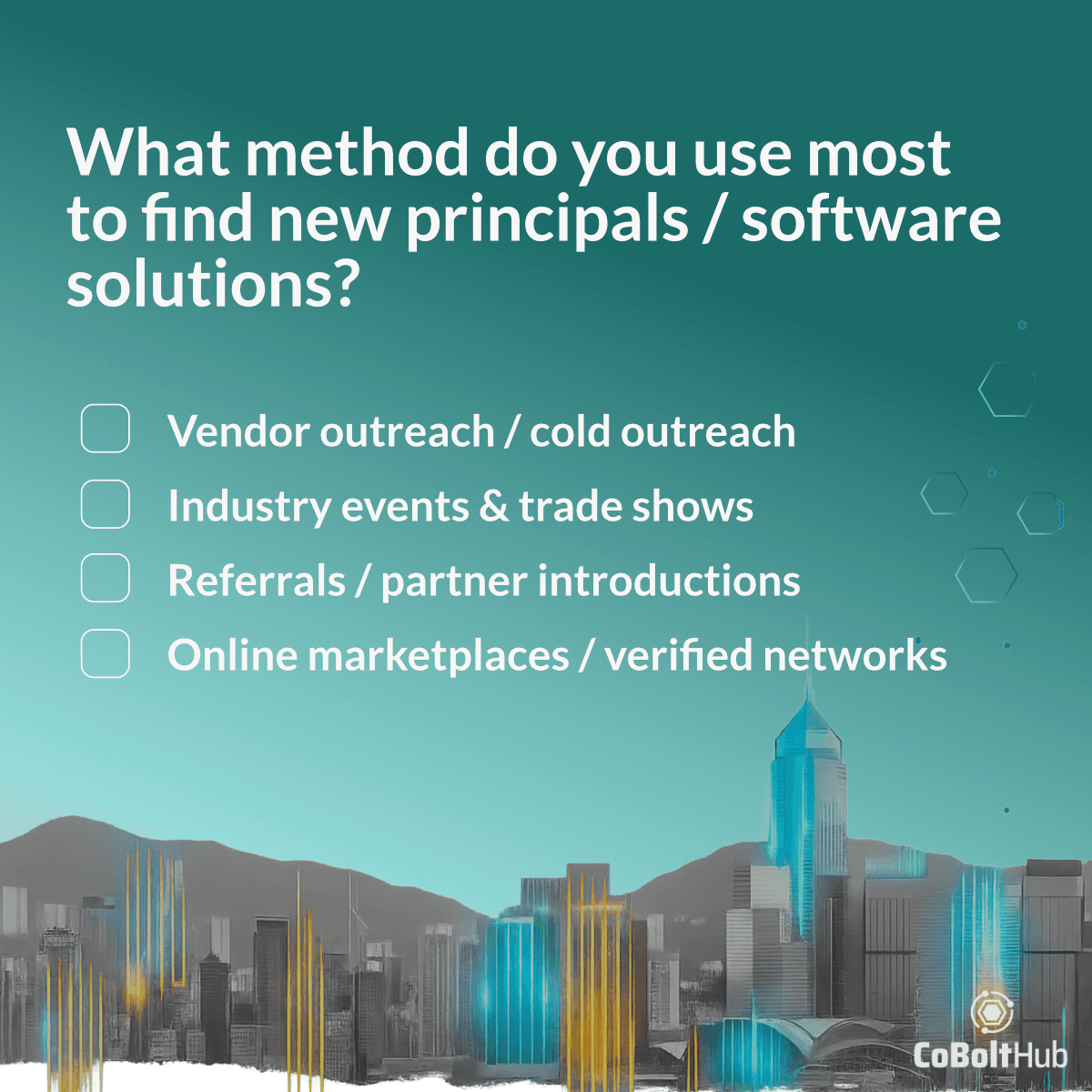
The Poll Was Simple. The Problem Is Not.
Ask a room of Value-Added Distributors (VADs) how they find new software principals and the answers arrive with uncomfortable familiarity. Referrals from existing contacts. A search through a directory that lists everyone and ranks no one. A conversation that started at an industry event and went nowhere specific. A call from a vendor who happened to be passing through the region.
That is the shape of the poll question, and it is the shape of the problem. The methods are familiar because they are the only methods most teams have. CoBolt Hub's view is that the familiarity of these answers is not evidence that discovery works. It is evidence that discovery has never been given the tools it deserves.
The poll matters because it forces a choice. When distributors are asked how they find principals, they are really being asked whether they have a repeatable process or a set of habits. Most have habits. Habits are not a strategy.
The Hidden Cost of Informal Discovery
The channel does not lack willing participants. It lacks a structured way for the right participants to find each other at the right time. Forrester's analysis of partner ecosystems in 2025 notes that a significant portion of B2B revenue is now driven through partners, and that share is expected to rise, with the highest growth expected across distribution partners and digital routes to market1. The demand for good partnerships is not the constraint. The constraint is the discovery stage that precedes them.
When discovery is informal, the costs do not appear as a line item. They appear as outcomes:
- A distributor commits engineering resources to a principal whose roadmap does not match the market it serves.
- A principal spends two quarters courting a VAD that was never going to prioritise its product category.
- A portfolio gap persists for a year because no one could see which principals were actively expanding into the region.
- A compliance or stability concern surfaces after the commercial framework has already been discussed.
None of these failures are caused by a lack of effort. They are caused by a lack of early visibility. The status quo does not fail loudly. It fails quietly, one misaligned conversation at a time.
Directories compound this. A directory answers the question "who exists." It does not answer "who aligns." A list of every VAD in a territory, or every principal in a category, is not a shortlist. It is a starting point that still requires months of manual filtering, and it offers no signal about intent, readiness, or fit. Consultants can add judgment, but they add cost and latency in equal measure. Events generate business cards, not structured evidence.
Two Sides, One Structural Failure
The discovery problem is symmetrical, which is why it is so persistent.
From the principal's side, the challenge is proving capability before investing time. Principals evaluating VADs face a landscape where every candidate overstates strengths early. Certifications, vertical wins, and service depth are scattered across spreadsheets, decks, and memory. There is rarely a consistent framework for comparison, so decisions drift toward familiarity and reputation rather than evidence.
From the VAD's side, the challenge is being seen at all. A distributor with genuine technical depth and a strong regional footprint can still struggle for visibility because there is no structured place to present that depth in a way a principal can compare. The result is that strong distributors lose opportunities to better-known ones, and principals lose access to capable partners they never encountered.
Both sides are making consequential decisions with low-quality signals. That is the structural failure the poll quietly exposes. It is not that distributors lack options. It is that the options arrive without the context needed to evaluate them.
What Structured Discovery Actually Looks Like
CoBolt Hub's position is that discovery should be treated as a continuous workflow, not a series of isolated tasks. Each stage should build context for the next, so teams do not lose information, repeat work, or restart alignment when priorities shift.
That principle translates into a sequence that mirrors how good partnership decisions are actually made. A company builds a partner-ready profile that captures capabilities, coverage, specialisation, and intent. It defines an expansion plan with requirements and evaluation criteria before searching, so every decision that follows has structure. It searches and discovers aligned principals or VADs using filters, project criteria, and intent signals. It connects through consent-based introductions rather than cold outreach. It evaluates fit against predefined criteria, compares candidates, and tracks progress inside a single workflow. It monitors signals and outcomes over time through dashboards and analytics.
The distinction that matters is between existence and intent. A directory shows existence. A structured platform surfaces intent: which principals are actively investing in a region, which distributors are actively seeking a category, and which of them are ready to engage now rather than eventually.
This is where the poll's answers become actionable. If most distributors find principals through referrals, the platform does not replace referrals. It gives referrals a structure. It makes the informal signal explicit, comparable, and reviewable.
The Commercial Consequences of Doing Nothing
The cost of informal discovery is not abstract. It shows up in three places.
First, wasted business development spend. Every month spent evaluating a partner who was never going to convert is a month not spent with one who would. Prioritisation has to happen upfront, before relationships are built and expectations are set.
Second, risk in partner selection. When teams assess partners using inconsistent information, they elevate the wrong candidates. Consistent data on capability, coverage, and intent lowers that risk and makes it possible to elevate the partners who are actually ready to deliver.
Third, defensibility. A shared evaluation framework produces reasoning that is clear and reviewable. When a shortlist is challenged internally, the team can show its work. When it is not, decisions rest on personal conviction and are difficult to defend.
There is also a timing dimension that is easy to miss. Markets shift faster than most companies can adapt. New regions open, others contract, and ecosystems reshape themselves in real time. In that environment, the ability to see quickly which partners are capable, aligned, and ready is not an operational detail. It is a competitive differentiator. If a distributor cannot see which principals are signalling intent in its region, someone else will see it first.
Why This Matters for Both Principals and VADs
The value is mutual, and that mutuality is the point.
For principals, structured discovery means knowing who is serious before engaging. It means comparing partners on operational truth rather than on the confidence of the pitch. It means running an expansion plan as a workflow with criteria set in advance, so shortlists are backed by verified data and real intent rather than assumptions and closed networks.
For VADs, structured discovery means showcasing capability in a way principals can compare, matching business strengths to principal intent, and leading evaluations with authority using guided templates and consistent criteria. It means only investing time in principals who can genuinely win with you.
The poll question, in other words, is not really about which method a distributor uses. It is about whether the method produces a defensible decision. A referral that has never been tested against criteria is a guess with a friendly face. A directory entry that has never been checked for intent is a name, not a partner.
A Sensible Limitation
CoBolt Hub does not claim to remove judgment from partner discovery. It cannot tell a distributor which principal will succeed in its market, and it does not replace the strategic thinking that a strong commercial team brings. What it does is make sure that judgment is applied to structured, comparable information rather than to scattered impressions. The platform improves the quality of the inputs. The decision remains a human one.
What Better Discovery Changes
If the poll's answers cluster around referrals, directories, and events, that is not a verdict on the people answering. It is a verdict on the tools they have been given. Discovery has been treated as the informal prelude to the real work. CoBolt Hub's view is that it is the real work, and that everything downstream depends on getting it right.
The practical implication is straightforward. Teams that structure discovery surface misalignment early, reduce partner risk, and accelerate decisions. Teams that do not will keep discovering the same problems, only later, when they are more expensive to fix. The question is not whether the channel needs better discovery. The poll already answered that. The question is who moves first.
CoBolt Hub - CoBolt Hub is a structured partner discovery platform for software principals and Value-Added Distributors, built around capability, coverage, and intent signals.
Sources
Footnotes
-
Forrester: The State of Partner Ecosystems In 2025 - Forrester reports that a significant portion of B2B revenue is now driven through partners and that this share is expected to grow, with the highest growth anticipated across technology partners, distribution partners, and digital routes to market. ↩