

The Introduction Problem Nobody Budgets For
You found the distributor. You did the research. You know they cover your region, carry adjacent solutions, and have the engineering bench to support your product.
So you send a link to your website.
Excellent. The recipient now has homework. They must open your homepage, scroll past a hero banner about your mission, hunt for a coverage map, guess whether your roadmap overlaps their portfolio, and then decide whether you are worth 30 minutes. Most will not bother. Not because your product is weak, but because you asked them to do unpaid analysis on your behalf.
That is a strange way to start a partnership.
Your Website Is Not a Partnership Pitch
Your website is built for buyers. It speaks to a procurement committee, a technical evaluator, and a finance signatory. It explains your company to the world at large.
A potential partner needs something else entirely. They need to know what you want in their market, which territories you are prioritising, which verticals you are chasing, and whether you will actually invest in enablement once they sign. None of that lives on a homepage. It cannot, because your homepage is not addressed to them.
So the introduction becomes a PDF, a deck, and a calendar link. Three artefacts, four attachments, zero signals of intent.
ConnectCard Puts the Reason to Care in One Place
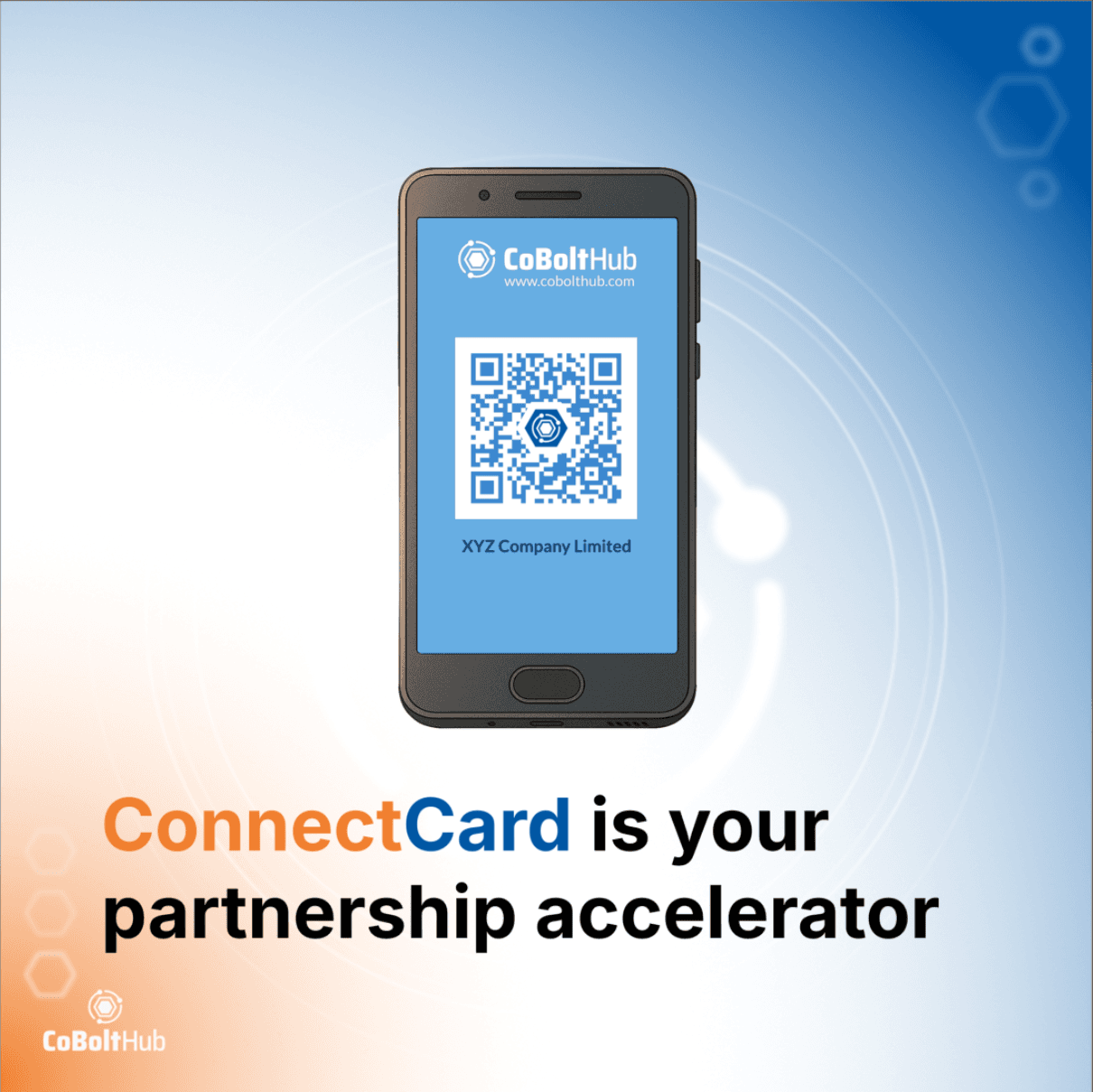
ConnectCard by CoBolt Hub replaces that scattergun introduction with a single, shareable, partner-ready card. It is not a business card with a logo on it. It is a structured pitch that carries the specific context a partner needs to decide whether a conversation is worth having.
One link. Coverage, capability, focus markets, and intent, presented in the format a partner actually evaluates.
For software companies, referred to as principals in the channel, and Value-Added Distributors (VADs), that changes the first ninety seconds of every relationship. The reader is not decoding you. They are assessing fit.
What Each Element Actually Buys You
A card that states your target markets tells a VAD whether their territory is in scope before they reply. That is not decoration. That is qualification happening before the first call.
A card that states your intent signals tells a principal whether you are actively recruiting a partner or passively listed everywhere. Intent is the difference between a distributor prioritising your line and adding it to a folder.
A card that carries your capability and coverage tells both sides whether the operational fit exists. Certifications, vertical wins, service strengths. The things that normally surface in week six of a conversation, available in the first message.
That is time saved. Time that used to go into discovery calls that should never have been booked.
Both Sides Are Choosing
Here is the part most outreach ignores. The partner is evaluating you too. They are asking whether your roadmap is credible, whether your margins support their cost to serve, and whether you will still care about their region in eighteen months.
A generic introduction answers none of that. A ConnectCard answers some of it before the question is asked, which is precisely why it gets a reply.
Principals get faster qualification and fewer dead-end conversations. VADs get a comparable, structured view of principals instead of a pile of inconsistent decks. Both sides spend their attention on partnerships that have a reason to exist.
One Honest Limitation
ConnectCard cannot rescue a weak proposition. If your product has no differentiated value in a market, a beautifully structured card will simply help a partner reach that conclusion faster. Consider that a feature, not a flaw. Faster no is cheaper than slow maybe.
Build the Card, Then Send It
Your website explains your company. ConnectCard explains why this partnership deserves attention. Those are different jobs, and only one of them belongs in an introduction.
Build your ConnectCard and give the right partners a reason to respond.
CoBolt Hub - CoBolt Hub is a structured partner discovery platform for software principals and Value-Added Distributors, built around capability, coverage, and intent signals.