

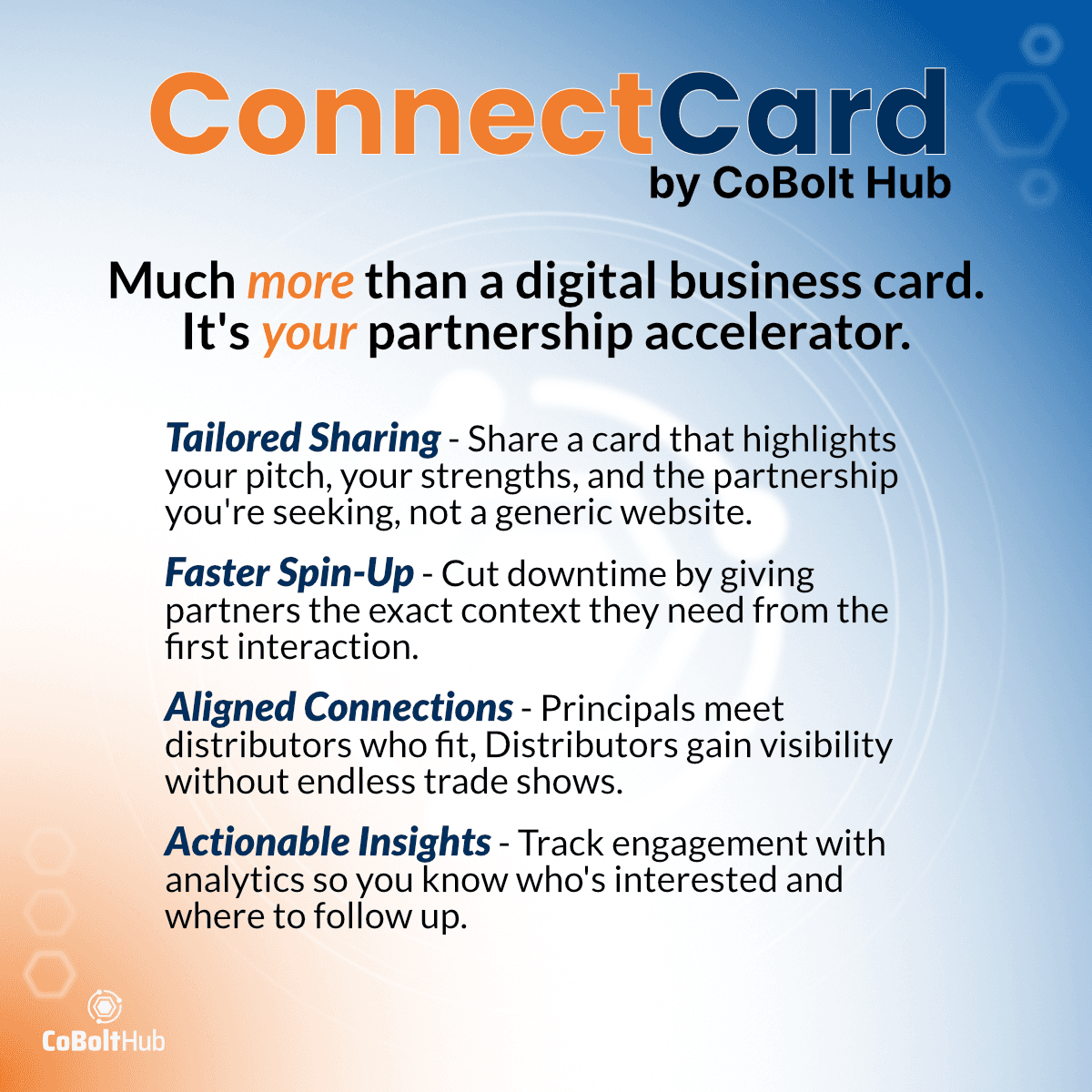
ConnectCard: Stop Excavating Your Website
You meet a promising VAD at an event, exchange a quick intro, and promise to follow up. Then comes the hard part. You send a polite email with a link to your website and ask them to "take a look."
Excellent. The recipient now has homework.
They click through to a homepage designed for end customers, not partners. They scroll past product screenshots, case studies, and a career page. Somewhere between your About Us and your pricing FAQ, the reason they should care about this partnership quietly suffocates. You follow up a week later. Crickets.
That is not a bad partner. That is a bad pitch.
Your Website Is Not a Partnership Pitch
Here is an uncomfortable truth: your website was built to explain your company to the world. It was not built to convince a Value-Added Distributor (VAD) that your product deserves a place in their portfolio.
Your website answers questions nobody in a partnership conversation asked. It tells a VAD who you are, not why you and they should build something together. It buries the commercial case under navigation menus, cookie banners, and a product tour that assumes prior context.
And yet, this is how most software companies, referred to as principals in the channel, and Value-Added Distributors (VADs) open a partnership conversation. They do not pitch. They point.
That is the difference between an introduction and an argument. An introduction says "here is our website." An argument says "here is why this works, here is what we bring, and here is what we need from you."
ConnectCard Puts the Reason to Care in One Place
ConnectCard by CoBolt Hub replaces the website excavation with something far more direct: a single, structured pitch card built specifically for partner conversations.
Think of it as a landing page that does one job. It captures who you are, what you are building, which markets you are targeting, and what kind of partner you are looking for. No navigation. No distraction. Just the case for a partnership, compressed into a format the recipient can actually absorb.
Where your website asks the VAD to go hunting, ConnectCard hands them the answer. It is the difference between "go explore" and "here is exactly why this matters to you."
What ConnectCard Actually Does
ConnectCard is not a digital business card with a QR code and a nice font. It is a structured pitch that front-loads the commercial logic.
A strong ConnectCard answers three questions in seconds:
- Who are you? Not your full history. Enough to establish credibility.
- What are you building? The product, the category, and the momentum.
- Why should a partner care? The market opportunity, the margin potential, and the support you bring.
That third question is where most partnership pitches collapse. Principals spend hours on their product story and almost no time on the partner story. ConnectCard forces the partner story to the surface, because that is the story that gets a response.
The digital business card market is already compounding at over 11% annually, driven by the shift to mobile-first, structured sharing. But most of that growth is still built around contact details, not commercial context. ConnectCard goes further: it packages the pitch itself, not just the contact info. That is the difference between handing someone your phone number and handing them a reason to call. 1
Why This Matters for Principals
For principals, ConnectCard is a sales enablement asset that works before the first meeting even happens.
Instead of sending a VAD to a website and hoping they self-navigate to the right conclusion, you send a card that makes the conclusion obvious. The VAD sees your market focus, your capability, and your intent in one glance. They can evaluate you before they ever commit to a call.
That is time saved on both sides. And in channel expansion, time is the most expensive line item you carry.
Why This Matters for VADs
For VADs, ConnectCard does the reverse. It gives you a clean, comparable way to assess a principal before you invest in discovery.
Instead of excavating five different websites to understand five different partnership opportunities, you get five structured cards that speak the same language. You can compare market focus, product maturity, and enablement commitment without a spreadsheet and a weekend.
That is the quiet superpower of structured discovery: it makes comparison possible. And comparison is what turns a list of options into a defensible decision.
ConnectCard Does.
Your website explains your company. ConnectCard explains why this partnership deserves attention.
One is a reference library. The other is a pitch. When a VAD has ten principals to evaluate and six hours to do it, only one of those gets opened twice.
CoBolt Hub is built around this same philosophy across the entire partner journey. ConnectCard is the opening move: a structured, intent-rich pitch that replaces cold outreach and blind introductions with a clear, consent-based first step. It is where discovery stops being a guessing game and starts being a workflow.
A quick note on what ConnectCard cannot do. It cannot rescue a weak proposition. If the product is undifferentiated, the market is saturated, and the commercial terms are uncompetitive, no card will save the conversation. But if you have a real opportunity and a genuine need for partners, ConnectCard makes sure that opportunity is actually seen.
Build your ConnectCard and give the right partners a reason to respond.
Stop asking VADs to excavate your website. Put the reason to care in one place, and let the right partners find you on CoBolt Hub.
CoBolt Hub - CoBolt Hub is a structured partner discovery platform for software principals and Value-Added Distributors, built around capability, coverage, and intent signals.
Sources
Footnotes
-
Digital Business Card Market Outlook 2025 - Global digital business card market growth data cited to contextualize the shift toward structured, mobile-first sharing in B2B. ↩