

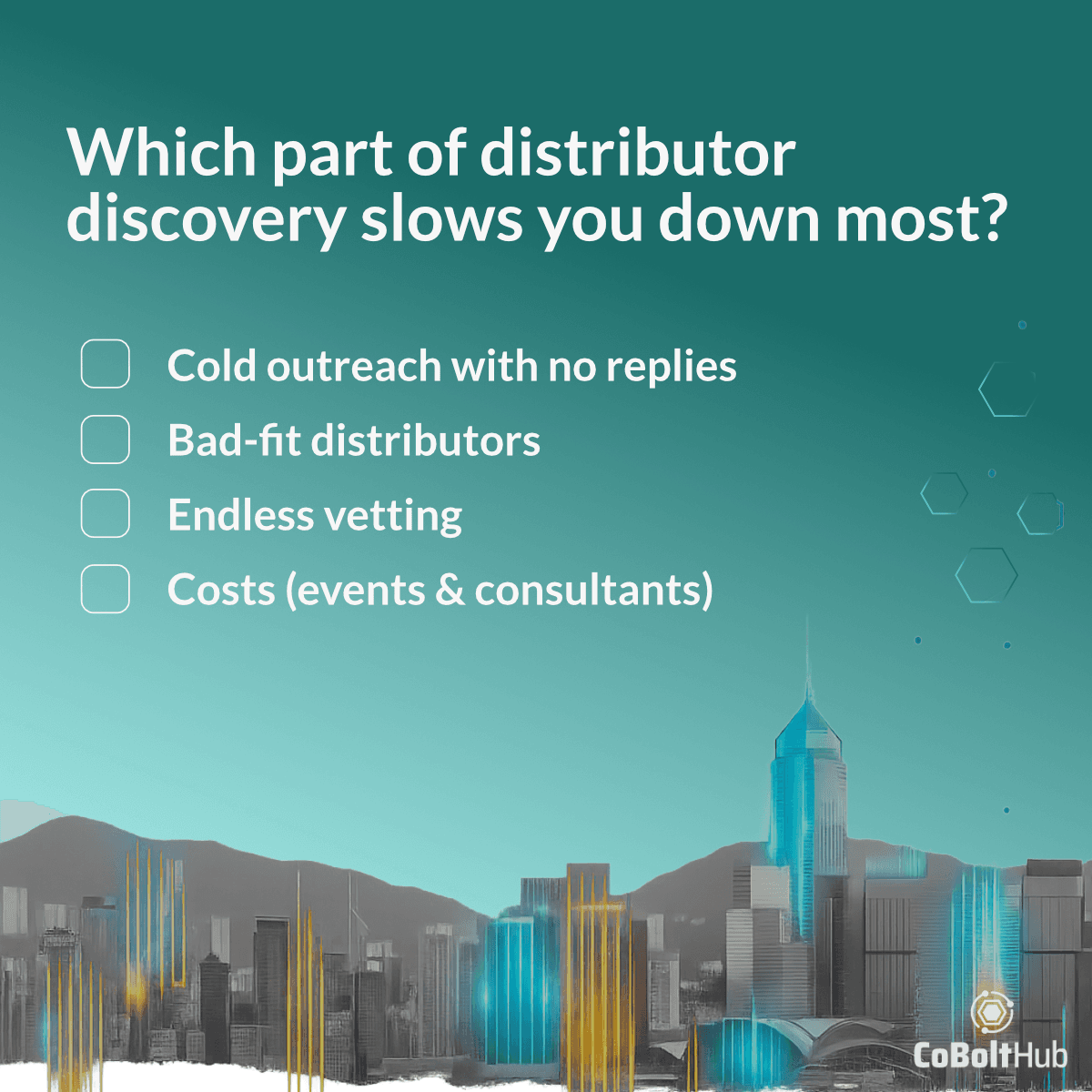
The Question Everyone Answers Differently
Ask any channel leader to name the biggest pain in their partner relationships and you will get a different answer depending on the room. Sales teams point to misaligned incentives. Operations teams cite onboarding friction. Executives blame slow go-to-market cycles. And distributors, caught between vendor expectations and customer demands, often describe something closer to a structural problem than a tactical one.
CoBolt Hub ran this exact question as a poll, and the pattern that emerged was not a single dominant complaint. It was a cluster of symptoms pointing back to one root cause: the discovery stage. The moment before a partnership formally begins, where both sides decide whether the other is worth the investment, is where most partner pain is born.
The evidence supports this. IDC's Global Partner Survey, fielded across nearly 2,500 senior stakeholders at partner organizations worldwide, shows that partner organizations are rethinking their vendor relationships in real time, with portfolio competitiveness anxiety doubling year over year as partners evaluate which principals deserve their limited capacity.1 When partners are actively questioning whether the vendors they already work with are the right ones, the cost of poor discovery is no longer an abstract concern. It is a measurable drag on revenue.
Why the Poll Matters
A poll is a small data point. But when the question is about pain, the answers tell you where an industry is spending its energy. What the responses to our poll revealed is that the channel is not suffering from a shortage of potential partners. It is suffering from a shortage of clarity about which partners are genuinely aligned, capable, and ready.
That distinction matters. The channel does not have a visibility problem in the sense that partners cannot find each other. Directories exist. Conferences exist. LinkedIn exists. The problem is that these channels surface names, not alignment. They tell you a company exists, not whether it can actually deliver in your market, for your product, with your expectations.
The Hidden Cost of the Status Quo
The conventional approach to partner discovery relies on a combination of brand familiarity, legacy networks, and the occasional consultant. Each of these has a cost that is rarely accounted for.
Brand familiarity rewards incumbents, not the best fit. A principal that has been in a region for ten years will always be more visible than a newer distributor with stronger capabilities and more genuine intent. Legacy networks compound this by keeping decisions inside a closed circle of relationships that may no longer serve either side. And consultants, while useful, are expensive, slow, and ultimately deliver recommendations based on their own limited vantage point.
The result is that both software principals and value-added distributors (VADs) routinely invest months evaluating partners that were never going to convert. Business development teams spend cycles on conversations that reveal nothing about intent. VADs with real skills struggle for visibility while larger, less committed competitors dominate the conversation. And when a partnership does progress, both sides discover misalignment only after contracts are signed, resources are committed, and the cost of course correction has multiplied.
This is not a failure of execution. It is a failure of the discovery model itself.
What Partners Actually Need
When we separate the poll responses from the vocabulary, the underlying needs are consistent. Both principals and VADs want the same three things from the discovery process.
First, they want to know who is serious before they invest time. Real intent signals, whether a partner is actively investing in a region, whether their stated focus areas match their actual behavior, whether they respond with speed and specificity, are worth more than any brochure. Second, they want comparable information. Certifications, vertical wins, service capabilities, and delivery processes should be visible in one place, not scattered across spreadsheets, consultant summaries, and memory. Third, they want a defensible process. When a shortlist is built on structured criteria rather than gut feel, the decision can be explained, reviewed, and repeated across markets and teams.
None of these needs are radical. They are the same standards applied to almost every other high-stakes B2B decision. The channel simply has not had the infrastructure to support them.
The Case for Structured Discovery
CoBolt Hub's view is that partner discovery should be treated as a continuous workflow rather than a set of isolated tasks. The early stage, before onboarding or management even begins, is where the highest-value decisions are made, and it is also where the least structure exists.
A structured discovery model replaces assumptions with shared data. It allows principals to define market entry goals and partner requirements before searching, so that every decision that follows is measured against explicit criteria. It allows VADs to present their capabilities, coverage, and intent in a way that is comparable rather than anecdotal. And it allows both sides to evaluate fit with a consistent framework, so that a decision made in Singapore can be defended in London, and a shortlist built in March can be revisited in September without losing context.
The commercial consequences of skipping this structure are not theoretical. When discovery is informal, teams lose information between stages, repeat work, and restart alignment when priorities shift. When evaluation is subjective, decisions become harder to defend to corporate stakeholders. When intent is invisible, both sides waste time on conversations that were never going to go anywhere.
The Two-Way Fit That Most Tools Ignore
One of the most revealing findings in our poll was how often both sides described the same pain from opposite perspectives. Principals complained that every VAD overstates its strengths early. VADs complained that principals list themselves everywhere without signaling genuine commitment to any specific market. Both are describing the same problem: a discovery environment that rewards self-promotion over evidence.
A healthier model requires both sides to prove readiness before asking the other to invest. A principal should be able to show which markets it is actively targeting, which industries it plans to grow, and which resources it is prepared to commit. A VAD should be able to show its delivery capabilities, its vertical experience, and the types of solutions it is genuinely seeking. When both sides surface this information in a structured, comparable format, the conversation shifts from persuasion to evaluation.
This is the shift that CoBolt Hub was built to enable. By focusing on the first mile of partner discovery, before contracts or onboarding, the platform helps teams surface misalignment early, reduce partner risk, and accelerate decisions. Instead of fixing problems downstream, organizations start with clarity.
What the Data Says About the Stakes
The scale of the problem is larger than most channel leaders appreciate. IDC's 2025 Global Partner Survey, which captured responses from nearly 2,500 senior stakeholders across North America, Latin America, EMEA, and Asia-Pacific, found that partner organizations are actively reshaping their vendor relationships, with portfolio competitiveness anxiety doubling year over year. Partners are not waiting for vendors to improve their programs. They are evaluating alternatives, and the vendors that make themselves easy to evaluate, with clear signals of capability, coverage, and intent, will be the ones that get the first call.
This is the commercial reality that makes discovery a competitive differentiator rather than an operational step. In a market where partners are actively reconsidering their portfolios, the principals that appear with clarity and intent will win the evaluation. The ones that rely on brand familiarity and legacy relationships will find themselves quietly displaced.
The Practical Implication
The practical implication of better discovery is straightforward: decisions become faster, more defensible, and more likely to lead to partnerships that actually work. Business development teams stop spending months evaluating partners who were never going to convert. VADs with real capabilities gain visibility that their marketing budgets could never buy. Both sides enter conversations with the confidence that comes from real signals rather than surface-level claims.
CoBolt Hub's view is that this is not a nice-to-have. It is the foundation on which every subsequent stage of the partner journey depends. Onboarding is smoother when both sides already understand what they are getting into. Enablement is more effective when the partner was selected for genuine alignment. Revenue targets are more achievable when the partner was chosen for capability rather than convenience.
The question is no longer whether structured discovery is worth the effort. The question is whether organizations can afford to keep discovering partners the old way, when the cost of misalignment is compounding and the competitors who embrace structure are already moving faster.
Start with Fit, Not Fixes
The biggest partner pain, as our poll revealed, is not any single operational friction. It is the accumulated cost of discovering partners badly. Every wasted cycle, every misaligned expectation, every partnership that needed fixing instead of building, traces back to that first mile.
Organizations that invest in structured discovery are not just avoiding those costs. They are building a repeatable advantage. The same evaluation framework that works for one market can be applied to the next. The same intent signals that surface a strong VAD today will surface another next quarter. The same defensible process that satisfied corporate stakeholders in this expansion will satisfy them in the next.
The channel has spent years building better tools for managing partners after they are onboarded. The gap, and the opportunity, sits earlier in the journey. Discovery is the most important part of any partnership, and it is the part most organizations have left to chance. That is the pain worth solving, and it is the one worth solving first.
CoBolt Hub - CoBolt Hub is a structured partner discovery platform for software principals and Value-Added Distributors, built around capability, coverage, and intent signals.
Sources
Footnotes
-
IDC Global Partner Survey, 2025 - IDC's 2025 Global Partner Survey fielded responses from nearly 2,500 senior stakeholders at partner organizations across North America, LATAM, EMEA, and Asia-Pacific, covering partner business models, vendor relationships, and portfolio competitiveness concerns. ↩